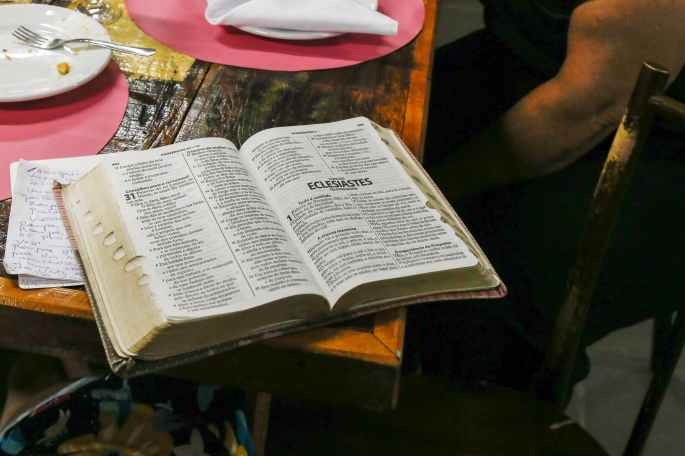
A Bible Reading Plan That is Music to My Ears

This time of year is often filled with many things that can tend to keep us busy.  With the business of life, we can often let some of those things that we really want to do fall by the wayside.  One of those things may well be your Bible reading plan.   If you are anything like me, it is always my goal to read the Bible through at least once a year.  It is usually this time of the year when I start looking for the next plan or guide to help me read through the Bible in a year.

Over the years I have tried many different plans.  Some that were good, and others that I didn’t care for as much.  The one that has been a good fit for me the last few years has been the 5 Day Bible Reading Program.  It is the one that I plan to use again this year.  It works best with my busy travel schedule.   Yet, this year I am adding a bit of a twist to my reading plan.  Often, when I am reading the Scripture, a hymn tune will pop into my mind that pairs well with the text I’m reading.  I love hymnody . . . both old and new.  I love to read and hear theologically rich lyrics paired with beautiful music.  I love to sing.  So, this past year I started jotting down the hymns that came to mind as I read the Scriptures each day.  I have now compiled a list of hymns, along with links to each tune on YouTube, that I plan to use each day to add to my time with the Lord.  I believe it will enrich my quiet time that I seek to have each day. 

 I compiled this list really for me, but if you would like to follow along this year as I read the Word and sing the Word, I would love for you to do so.  You may even find some new songs along the way.  You may or may not want to listen to the versions of the songs that I have chosen.  That is totally understandable and completely up to you.  You may choose instead to simply read the hymn from your favorite hymn book.  This too would provide spiritual nourishment as well.  You can find the vast majority of the listed songs in the Hymns of Grace hymnal, my preferred hymn book. So, open up a songbook and read the great songs of our faith along with your daily Bible intake.

You can check out (or print) a copy of the Reading and Listening Plan here.

If you would like a playlist of the songs, you can look for a Spotify playlist coming soon as well.   

Soli Deo Gloria,

Adam B. Burrell

No, Your Teen Doesn’t “Need” a Smartphone

I know what you are thinking after reading the title.  Maybe you have a teen or pre-teen and you are trying to decide whether or not to get them a phone.  You may be thinking, “Yes, I know they might end up spending too much time on their phone, but I will feel safer knowing that they have one.  I’ll be able to check on them whenever I want to see exactly where they are.  I’ll be able to call them any time I need them and they’ll be able to get a hold of me any time that they need.”  When the subject comes up with your kid all you hear is, “Mom/Dad all of my friends have one.  How am I supposed to keep up with what is going on if I don’t have one? This is just how things are living in our world today, you know?  If I don’t have one then I am going to be made fun of.  I will be the only one of my friends without one.”  I know it can be hard to say “no.”  You can rationalize the good in your mind.  But, I want you to strongly consider saying, “no” to that Smartphone request.   If you say, “no,” know that you will be in the minority.  However, I truly believe that you and your family will be far happier and safer if your teen doesn’t have one in their hands.  I believe that it is most wise to say no to the Smartphone until after High School.  Let me provide a few reasons as to why.

The Addiction Factor:

Let’s face it, Smartphones are addictive.  Most anyone can see it, and recent statistics confirm it.  We also know that many teenagers already deal with compulsive behavior.  Putting addiction and compulsion together is a receipt for disaster.  This is not just a teenager issue.  The reality is many adults, who didn’t grow up in the digital age, have a near addiction to their Smartphones.  If adults have a hard time finding the balance with Smartphones, teens who are still trying to learn these skills have little chance of overcoming it on their own.   According to a recent article by Harvard University, when a person gets a social media notification, their brain sends a shot of dopamine to the brain causing a euphoric experience.  Dopamine is most often associated with food, exercise, romance, sex, gambling, drugs, and now that little black pixelized box in the hands of hundreds of millions of people. When many of our teens struggle enough with compulsive behavior does it seem wise to give them something that is going to tempt them toward that end even more?  Paul, in I Corinthians 9:27 writes, “but I discipline my body and keep it under control, lest after preaching to others I myself should be disqualified.”  In this day and age it takes discipline to control our phone habits; discipline that many teens lack the desire or self-government to do.  If we want to help our teens hone in on discipline and self-control then putting a smart phone in their hand will likely contradict this.           

The Pornography Factor:

When many of us were teens pornography was hard to come by (praise the Lord).  But that is not true in today’s world.  27% of all unfiltered internet is pornographic.  In 2020 a study was done that showed some 51% of all 11-12 year-olds polled were aware of and had access to pornography, 13-14 year-olds . . . . 66%, 15-16 year-olds . . . an astonishing 79% .  It is available on almost every social media platform.  The accessibility to pornography is near unfettered.  If a teen has a Smartphone, internet access, and a desire to see pornography, they can find it in a matter of seconds.  Pornography can rob your soul (Matthew 16:26).  It can cost personal relationships (Ephesians 5:3).  It can cost a person sexual joy with their future spouse (Song of Solomon 8:4).  Paul says that we are to “Flee sexual immorality”(I Corinthians 6:18).  A loving father or mother would not give their child a pornographic magazine nor a XXX movie for their birthday.  However, you are inviting these things into your home and the mind of a pubescent curious teen by giving them a Smartphone.  You may not be able to keep your son or daughter from having lustful thoughts, but you can keep the digital temptation and call of the Siren out of their hands.              

The Time-Sink Factor:

According to Common Sense Media, 53% of American children own a Smartphone by age 11.  The average teen in the U.S. spends some 7 hours a day on their Smartphone (outside of school and any extracurricular activities.)  This is a lot of screen time. Just like adults, teens can easily get sucked into the blue faced vortex of their Smartphone as they mindlessly scroll through social media.  The Apostle Paul commanded the church in Ephesus to redeem the time, because the days are evil (Ephesians 5:16).  There is a place for leisure.  There is a place for playing games, reading articles, and catching up with friends.  But, we all know the allure of that digital mistress.  Teens have so many wonderful things that they could be doing with their free time that could be productive.  Time is a gift from God for teens.  They will never again have as much free time as they do now.  This is precious time that they will never get back.  Smartphones can be the source of a massive waste of time if not checked.  Time is a gift.  Help your teens to be good stewards of it.      

The Safety Factor:

Many parents may think that there is more danger outside of the home than in the digital world.  But recent statics have shown that violent crime has significantly dropped over the past 30 years.   One of the most dangerous places for teens to be today is actually online. Cyberbullying is no joke.  It is reported that between 50-60 percent of teens who are on social media have been cyberbullied.  Since the invention of the Smartphone 10 years ago teen suicide rates have quadrupled.  Diagnosed anxiety has more than doubled since the invention of the Smartphone.  These are some alarming statistics, both of which are closely tied to Smartphone usage. 

Yet, bullying is not the only danger.  There is story after story about predatory behavior as well.  It can come in the form of sexual, emotional, or psychological abuse through apps and other online sources.  This can happen without the other person ever being in the same room.  Sadly, some of these encounters have eventually led to real physical abuse.

Now this isn’t limited to Smartphone users.  This can happen through any device that hooks up to the internet.  But know this: if your child’s Smartphone connects to the internet the safety factor increases exponentially.  Jesus told his disciples, “be wise as serpents and innocent as doves” (Matthew 10:16).  As parents we must heed these words from Christ when considering the safety of our teen or pre-teen.  You must ask yourself, “Am I being as wise as a serpent when considering this phone?”  Because, I promise, smartphones are not nearly as innocent as they may seem.   

Applying Wisdom

What I have laid out here, I believe, it to be based on biblical wisdom.  I am aware that a Smartphone itself is not sinful.  However, we must ask if it is wise and best for our teenage sons and daughters? I know there are circumstances where a Smartphone may be necessary for your teen (to monitor their health for example).  I know in this day and age it will likely put your teen on the outside looking in with their friends.  But remember this: you are their parent.  You get to decide what is best for them, not their peers.  Not society.  Don’t give in to your son or daughter’s tears or youthful persuasion.   You are going to stand before God to answer for how you shepherded your home.  Fathers, you particularly will be judged on how you protected your family as the head of your home in this matter.  So, I ask you to sincerely consider what has been written here before busting out your credit card for another monthly payment on that $800 iPhone for your 13-year-old.  However, if you have prayed through it and you still believe that your teen “needs” a phone, let me provide a couple of safe(ish) options for you. 

The Gabb Z2 phone: 

It looks like a Smartphone, but without the worries.  It has no social media, no web browsing, no games, and no app store.  It cannot hook up to the internet at all.  So, no worries.  What you do get with it is 14 essential apps: music, phone, messaging, contacts, camera, video, gallery, calendar, calculator, clock, voice recorder, FM radio, file manager and settings.  It also has a built in GPS.  If you are looking for a smart phone that isn’t so smart, this one might fit the bill (It is only $100).

The dumb phone: 

That’s right, a simple flip phone that we all had back in the day that takes horrible pictures and can only text and call.  If your teen needs a phone, the old trusty flip phone may be the best choice.

No phone at all:

I think it is wise to have an extra cell phone or two for your family.  When your children are old enough to drive it seems wise that they would have a phone with them in case it is needed while driving.  However, I know many families who just have a “family cell phone” that they grab while going out the door.  It isn’t any one person’s phone.  It is just for the purpose of having access to the phone when it is needed.  It is not constantly on a person but is picked up when walking out the door.   

Concluding Thoughts          

My final admonition as I close would be to take 90 minutes to sit down with your spouse  and watch the film Social Media Dangers Documentary — Childhood 2.0.  I am convinced that it will open your eyes to a world that you may have never knew existed, but it is one that your teen or soon-to-be teen will live in (for better or worse) when it comes to Smartphones and social media.  May the Lord guide you in this area with his rich biblical wisdom.  And for the sake of your children and future grandchildren remember this little proverb: when it comes to a phone for your teen, the dumber it is, the wiser and better off your kid will be.

Soli Deo Gloria,

Adam B. Burrell

“How I trained my little ones to sit still and quiet” (by Jessica Burrell)

This is a follow-up post to my previous post Help, The Church Nursery is Closed! in which I reference training your children at home to be content to sit quietly.  Once you are out in public, it is too late to ask them to behave in some new way that you have never taught them.  This post is an effort to convey how I trained my little ones in the peace and comfort of our home.  The Lord says to train up our children in the way they should go (Prov. 22:6), to train them in the discipline and instruction of the Lord (Eph 6:4), and to teach them to have a quiet and gentle spirit, which the Scriptures say is “precious in God’s sight” (1 Pet. 3:4).  I have tried to apply these Scriptures in some practical ways at home while teaching my children to sit quietly and respectfully.

So how do you start? Start slowly.  Start with 5 minutes, maybe less.  Sit on the couch with Mommy and children together reading a book or singing a hymn, all engaged in the same activity.  The purpose is to stay in the designated place for the duration of the time.  Most children love this quality time of having Mommy’s attention to themselves, and they rarely have any trouble complying.  The next step is to tell the child that they must read (or look at) their own book while Mommy reads a book separate from the child or works on something independent from the children, while still sitting on the couch right beside them.  In the first step, the child is the central focus.  In this second phase, the child will begin to realize that the point of being on the couch is not for Mommy to cater to their wishes, but rather for them to find contentment on their own.  While you need to be instructing the child in step one, this second step is more where reinforcing and teaching the child your expectations really comes in.  Tell the child “you may not squirm around and climb down to the floor.” And “Mommy has a timer set for 5 minutes. When it beeps, we will be all done.  Then you may get down and play.”  The child may not ask “how much longer” or similar questions.  The child must learn to be content to wait patiently until the time is done and Mommy says that it is time to get down.

I should clarify that “Still and quiet” time in our home meant no talking or moving around.  You stay in your place and entertain yourself with one quiet toy or book.  If this object was used to harass a sibling, it would be taken away, and the remainder of the time would be spent with hands folded neatly in the lap.  I do not exaggerate when I say that I can count on one hand how many times objects had to be taken away from my children in public.  They learned this lesson very well at home!  Consider anything a small child will normally do when they do not want to be still…roll around on the seat, scoot down to the floor, then they end up under the seat, or army-crawling to a nearby location.  Their innate intent is to push the limits and see how far is too far.  You as the mother need to decide what will be acceptable for your children while in public.  Are you okay with them sitting on the floor at the doctor’s office or crawling on the floor down to the end of the pew at church?  If not, be sure that you are firm in your training at home.  For us, no arm waving, clapping, or moving off the seat was permitted.  Depending on age, lying down quietly in one’s spot (not rolling) was permitted.

After the children have gotten the hang of a 5-minute interval of being quiet and occupying themselves with Mommy on the couch, the next step is to have Mommy get off the couch and do something else nearby, while leaving the children on the couch having their “still and quiet” time.  For example, I will tell the children to come and sit. Then, once they have been reminded of the rules of “still and quiet” time, I will step away while warning the children that I will be watching to make sure they do a good job.  I might sit in another area of the same room and make a call to schedule dental cleanings, while maintaining frequent eye contact with the children so they know I am paying attention to their behavior.  If a little one decides they aren’t interested in the training session, their behavior is quickly dealt with and they resume their time on the couch.  Quick and consistent discipline is necessary in this training time.  You will be training your children regardless of how you handle the situation.  While they are in the living room, it might be easy to warn them, “Mommy said get back on the couch… I mean it!”  But consider if this method will be an option in church or in the doctor’s office.  You want to train them to listen the first time, not the second or third.  They must learn to obey immediately and to realize that there will be swift consequences when they do not.  There will be no “easy out” if they disobey.  The training session will continue on after discipline has been handed out.

Once the children are able to sit quietly while you perform other tasks in the same room, the real test comes.  “Still and quiet” while Mommy leaves the room!  This was always our children’s favorite part of the training times.  I would have the children sit (they were permitted one quiet toy) while I left the room to set a timer and then come back in to check on them and see if they were still in the same place and quiet.  I might go put a letter in the mailbox but quickly return and pop in the room to surprise the children.  This can be a very fun activity.  The children never know what corner you might pop out around or what you might be wearing on your head when you return.  The “away” might be anywhere from 5 seconds to 15 seconds to begin with.  You want to help them keep their attention on the task at hand.  Don’t make this sitting session a miserable thing for them.  My children would often forget the toy they had in their lap and prefer to watch out for when I would pop my head back in the room to see how well they were doing.  I would give silent accolades whenever I peeked in and saw that the children were still doing as I had asked.

You may notice a natural progression in this: very small and familiar steps to begin with, then moving up to bigger steps.  This will not happen overnight.  I would recommend having a practice session every day, or a five-minute session in the morning and another one in the afternoon, depending on the age and personality of your child.

After the children can manage a 5-minute segment of time on the couch on their own with Mommy in and out of the room, it is time to add more time to the clock.  I would graduate them to 10-15 minutes on the couch with one quiet activity of their choice, whether it is a toy, a reading book, or a notebook with a pencil or crayon.  If the children are misbehaving or not obeying the way they should, the offending child must be removed and disciplined and brought back to resume their sitting time.  Meanwhile, the other children are expected to continue sitting quietly.  This has helped immensely during the years that my husband has been in a pastoral position and has been unable to assist me in the pew with the children.  I have been able to take the rowdy child out of the service to address behavior while leaving all of the other children (yes, even a two-year-old) sitting quietly in the pew without me in the room, knowing that they would sit still because they dare not be the next one leaving the sanctuary with me.

I have one last comment on praising your little ones for doing well.  Rewarding our children when they do well is not the same as bribery.  Bribery is a parent’s last attempt at getting what they want from their child.  It is a negotiation that puts the child in control of the situation and puts the parent at their mercy.  Rewards and positive affirmation for good behavior are very different than that.  When I ask my child to do something and they do it right away and with a cheerful heart, rewarding them in some way is a great way to help encourage and motivate the child to do it again.  They have honored me, and I want to bless them because of it.  This is a good and wholesome way to encourage good behavior in our children.

In my other post, “Help, The Church Nursery is Closed!” I talk about preparing for Sunday morning by starting on Saturday.  I mention that “less is more” when packing activity bags for kids in church or the doctor’s office, and I give a few other ideas like finding a seat near the exits and arriving early to claim it.

I hope this post has been an encouragement to you!  It is not always easy, and it is never a fast process to train up our little ones in the way they should go.  But, as the Lord commands us to do it, I hope this will be of some small encouragement to you as we strive to please Him!

Jessica E. Burrell

“Help! The Church Nursery is Closed!” (by Jessica Burrell)

Today has brought about many changes in our culture: schools shutting down and mask-wearing becoming a requirement in most establishments, to name a few.  Many of these changes in recent days affect our everyday life, even for the stay-at-home mom.  While we may be inconvenienced by some of the new CDC requirements, like trying to keep masks on our squirming children while in public, there are some challenges that prove more difficult than others.  As Christian mothers, one of the greatest difficulties we face may be that of the closing of the church nurseries.  Due to the light-speed way that children can transfer germs from one person or surface to another, most churches have closed down their nurseries for the time being.  This leaves parents with younger children only two options: stay home and live-stream the service from the living room, or attend church as a family, all in one pew, squirming children and all.  I will be approaching this issue as a sister in Christ, loving mother, and wife of a pastor.  This is a difficulty facing many young families today, and there is no easy answer.

Don’t Stop Going To Church

As hard as it may seem to take your family to church and sit in the pew with the entire family while you try to keep the young children quiet as the pastor preaches, this is your calling from the Lord.  Whether you are a pastor’s wife and your husband has to sit on the front row or stand in the pulpit while you try to manage the children in the pew alone, or whether you have two parents with grandparents able to help share the load, whether you are a single mom or dad bringing your children to church who have never once sat through a church service because they always go to nursery or children’s church, your God-given calling and obligation is to have your family in church – assembling together with the saints.  We might think that live-stream is an easy “out,” or a suitable alternative, but I would suggest that this is not the case.

Many churches are re-assembling with caution and are keeping live-stream available for those who are at risk and for those who are maintaining a “shelter-in-place” lifestyle.  For the rest of us, families included, we are in some part back to the grocery stores, vacations and outings.  If this is the case for your family, it stands to reason that you should be back to church as a family, as well.  There are many factors that could cause difficulties with bringing children into the church who are not used to sitting in the pews.  Regardless of the factors involved, this is no excuse to forsake God’s commands (Heb 10:25); this is simply a new growth opportunity that the Lord has placed in your path.  There is nowhere in the Scriptures that makes provision for the church to forsake the assembling together until nursery or children’s church is available.  No matter the age of your child or children, you need to be in church, and so do they.  As much as it is difficult to adjust to this (whether by choice or for lack of any other options), many of us are being required to turn “family integrated” for a time.  I know these are not easy words to speak, and I can say from experience that it is even harder to live out.  It can be a very difficult thing to adjust to, but just because it isn’t easy, doesn’t make skipping church an option.

How I Got Started on this Journey

For me, this journey started when I had four young children.  Our oldest was 6 years old (a girl). After her, we had three boys in a row (5, 3, and 16 months).  Our youngest son had seriously injured his hand and was in need of multiple surgeries and frequent doctors visits.  It was an hour drive to the Pediatric Hand Specialist’s office, and after having four young children strapped in their car seats for an hour, they were then expected to wait in a waiting room and accompany me into the patient room where the three oldest would have to be left without my watchful eye as I took their little brother to a nearby room for x-rays.  After we returned to the patient room, we would wait until the doctor arrived to discuss this very serious situation with me.  All the while, there were four children, 6 and younger, going completely stir-crazy and one frazzled Mommy trying to control the situation and have a coherent conversation with the doctor.  This was a very rude wake-up call for me when I realized that I had no choice but to somehow survive this situation again and again at every doctor’s visit, every x-ray, and every consultation.  It was impossible for my husband to take more time off work to help me after he had already taken time for two hospitalizations and hand surgeries for our little guy.  My only option was to train my children at home to behave the way I needed them to so that we could make it through all of these trips without chaos and tears for all five of us!

It may sound crazy to expect so much from a little one who many say can’t even reason yet, but there is nothing ridiculous at all about teaching your child to sit relatively still and occupy himself quietly for a little while.  As a matter of fact, I would go so far as to say that the parent who never trains their child to be still for a length of time is actually depriving their child of learning self-control at a younger age when it comes a little easier.  The practice of sitting “still and quiet,” or whatever you will call it, will be a blessing to you as the parent, as well as anyone you encounter.  You will also find that God rewards your child with a more content spirit when they are taught to be still for short periods of time.

Trust me when I say, “You can do this.”  But while you are sitting in a church service with 100 other people trying to listening to a 30-45 minute sermon, you will realize that this is NOT the time to teach your child how you expect them to behave.  This will only frustrate you and your child (Eph. 6:4).  You must work on training your child to sit quietly while in the comfort and safety of your own home.  If you are interested in the way I trained my children at home, please look for my follow-up post.  “How I trained my little ones to sit still and quiet”

Keeping Your Kids in the Pew Begins At Home

I would like to give a few practical pointers to help you wrap your mind around this concept.  From the early infancy age through toddlers and preschoolers with the wiggles, it is not easy to ask children to sit “still and quiet,” as we say in my home, for an hour-long service.  But they can do it.  It is also important to be considerate of those around you and not insist on keeping a screaming toddler in the service during his entire tantrum.  My first suggestion would be to find an area in the church that has easy access to one of the exits.  Next, plan to arrive at church early enough to claim this area for your family so that you ensure an easy exit if someone gets too rowdy or disruptive.

Next, you must plan for Sunday morning the night before.  You don’t want to show up to church frazzled and frustrated before the service has even started.  This will not help you to have the patience and grace needed to guide your children through the worship service.   Saturday night, be sure that all baths are taken care of, clothes are picked out and ironed if needed, shoes are found and matched, hair bows are selected, etc.  In our home, everyone must have Mommy approve their outfit before dinnertime on Saturday so that there is not “whoops” on Sunday morning.  Sunday morning your only goal should be to make sure everyone is clothed, fed, and ready to leave.  Once in the pew, I have found that less is more as far as busy activities go.  I used to pack a full bag of books, toys, snacks and crayons, only to find that at the end of the service I had an entire half-acre of mess to clean up.  Not to mention needing to offer apologies for the new “art” on the underside of the pews.

When thinking about your child’s needs for the service, pack appropriately according to their age.  If your child is able to write, give them a few writing tools and a notebook.  You can draw a word, for example: “God,” and your child can copy it.  Then you can draw a picture on one side of the page and your child can write it on the other side.  At this point their imagination usually takes over and they will doodle quite happily for a while.  If you have a young child, be sure that you pack pacifiers, quiet (and not messy) snacks, and a select few books and toys in a small bag that the child can access easily on their own to play with quietly.  As you make all of these preparations on Saturday night, remember that your training begins at home.  Be sure that your children understand your expectations before you get to the church.  We now have seven children in our home and can easily fill an entire pew.  There was a season when we had to assign each child their “spot” and tell them which siblings would be sitting on either side of them so that we would not have any arguments or disruptions in the pew.

Don’t Grow Weary – You Can Do This

Last of all: do not grow weary in doing good (Gal. 6:9).  There have been Sundays in church or weekdays in a doctor’s office that I wanted to throw my hands in the air and say, “I’m done training today!  We’ll be waiting in the car!”  We have had a few days when I had to abandon the grocery cart in the middle of the store and head to the van to deal with behavior that couldn’t wait.  What I came to realize was that the grocery shopping was not my highest priority.  Taking that moment to train my child would last a lot longer than those groceries did.  I would encourage you to keep the same perspective when sitting through worship.  Is it fun to take a child out and deal with behavior, walk back into church, only to have to leave and deal with them again?  No.  But what you are doing is training your child that this behavior is not an option.  No matter how many tantrums he throws, the result will be the same: correction and re-entering the service.  I would caution against staying in the foyer to allow the disruptive child to play for the rest of the service.  If your child is having a day where he is completely uncooperative and is a distraction to everyone else in the sanctuary, look for a bench in the foyer to sit on.  But still practice sitting quietly during this time so he sees that his defiant behavior is not rewarded with playtime.  If this level of disobedience in public is common, maybe this is a sign that more time needs to be dedicated to training at home.

Although this task seems at times insurmountable, it is doable!  Trust me; I didn’t start until I already had four children.  Talk about challenging!  There were many times I wanted to give up.  I often felt as though there would never be a break and that I could never get a thing out of the worship service unless all of my children were tucked away in their classes and I could just focus on the pastor alone.  This is not true, though.  And as soon as we thinking that “just one thing” will make it all better, we need to make sure we aren’t manufacturing an idol in our hearts.  God didn’t give you a quiet pew without children.  God gave you those adorable rowdy children to love and care for, and He still requires you to come and worship Him.

I know that this may only be a short-term goal for you.  Perhaps you are only going to keep your children in the service until nursery becomes available again.  You must understand that this is a worth-while effort and a God-required effort you must make to bring your children to church.  We have to expel the notion that we are coming to church for our own selfish good.  First, we do this because the Lord commands it (John 14:15).  He gives us the desire for it, which is a blessing, but more than that, He requires it.  If it’s “no fun,” or “I don’t get anything out of it right now,” that’s okay.  You are honoring the Lord with your self-sacrifice.  Just remember that it’s not all about you.  It’s hard to live this out, but it’s true.  And for most of us, this season will get easier.  Our children don’t stay little forever.

We don’t have it all figured out.  And if you come to the church where we worship, you will see squirming kids, hear rustling papers, and probably even see a little one being taken out for a “talk.” And that’s a good thing.  Actually, if you were to come to church this week, you wouldn’t even see our whole family in the pew.  One of my children has a medical condition that has prevented her and me from returning to church yet. It is at this time more than ever I am so grateful for the Providential situation all those years ago when I was forced to teach my children how to be content to be still.  My husband is a pastor and elder in our church and cannot sit with our children during the entire service.  When he is on the platform, it is such a blessing to us both to know that our children have been trained to obey us and sit still and respectfully while he does what he needs to do.  That little 16-month-old with the hand injury is now six years old and sits quietly, taking what notes he is able to, or drawing a picture of his Daddy reading Scripture from the pulpit.  We don’t have it all together, and we never will.  But God has been faithful to do a work in our children, little by little.  We are weak vessels through whom the Lord has been pleased to exhibit His strength.

I hope this article has encouraged you and caused you to consider your responsibility for raising your children before the Lord.  If you are interested in a more how-to based article where I describe how I practically trained my children in these concepts at home, please look for my follow-up post.

Jessica E. Burrell

Is it Time to Reset the Family Table, Spiritually Speaking?

Imagine the scene at Thanksgiving.  You have the table set just perfectly.  You have the adults’ table, and the kids’ table with everyone’s plates, cutlery, and origami folded napkins prepared for your family to enjoy a wonderful meal together.  You have your spot for the turkey, your spot for the ham, and all the other fixings for your meal.  You know exactly where everything goes to make your Thanksgiving experience optimal.  Now picture something different: plates just tossed everywhere, no napkins, there is a fork here or there, and the spoons are actually dirty . . . oh, and the kids’ table has been completely forgotten.  Is this a picture of Thanksgiving bliss, or a recipe for disaster?  Any mother that saw this second scene would immediately rush to reset the table(s).

While most of us would like to think our homes function more like the hallmark picture that was painted first, the reality is, sometimes in our day to day family life we find ourselves at the second table and we just want to throw up our hands and throw in the towel.  Life gets hectic.  Children get disrespectful.  It can seem like everything is just flipped upside-down.  If this is the case in your home, as it is in mine at times, let me suggest something . . . it may be time to reset the table.

Resetting our Roles

Scripture clearly identifies the roles of all family members in the home.  God is the supreme authority in any Christian home.  Everyone must submit to Him and His Word.  If things seem to be flipped upside-down in your home, chances are the Lord is not looked at as the supreme authority there.  Next, we find the father is called to be the spiritual leader in the home.  He is to be the head of the house (Ephesians 5:23).  If things at home have gotten unruly, how is the father helping to straighten it up?  Since he is the head, he must be involved in the fix.  Next, we find the role of wife and mother.  While she is to be submissive to her husband, she also has been given the responsibility to be the keeper of the home (Titus 2:4-5).  In this role, she has authority over the children just as the father does.  And when we come to the children, their role is to be submissive to both mom and dad as they submit to the Lord.  This is the structure that the Lord expects in an orderly home.  And if your family table has dirty and broken dishes lying around, chances are, the roles have been subverted in some way.  It may be time for a reset.

Resetting our Responsibilities

Thinking through the roles in the home should allow us to see our responsibilities clearly.  When a child expresses their desire to “not eat their vegetables” with a loud but silent eye role of disgust . . . they need to remember their role.  A child is responsible to obey his or her father and mother (Ephesians 6:1).  Their responsibility is to eat that vegetable out of honor and appreciation (Philippians 2:14).  Their responsibility is not to offer an opinion (unless allowed by the parents), but to remember their role and respond appropriately. A mother has authority over the child and is to assist her husband in carrying out his responsibilities (Ephesians 5:22, Titus 2:4).  A father is charged with teaching, encouraging, and disciplining his child as well as loving and leading his wife (Ephesians 5:25-29, Ephesians 6:1).  In the home, everyone has responsibilities.  When spaghetti starts flying, or voices get raised in disagreement, chances are the responsibilities have been tossed aside.  This is when everything becomes a mess.  It is time for a reset.

Resetting our Relationships 

In many homes in America, the children rule the house.  While they do not pay the mortgage, the car payment, provide food to eat, shelter, or clothing . . . many children think that the home revolves around them and their needs.  And unfortunately, many parents allow this to happen.  At first, it is innocent and can even seem funny when your 4-year old says, “Mommy, get me some milk” while playing with her toys.  Yet, it isn’t nearly as funny, when your 16-year-old starts to tell you when and where they are going on Friday instead of asking permission to do so.  It can be easy to let their schedules rule us.  Many of us want them to be well-rounded and involved in a variety of things that stimulate personal growth.  So, we run them from the ball field to piano practice.  Then there are church functions and other school activities.  We become slaves to their schedule.  Then it happens.  The children become the center of all that is done.  The mother becomes the taxi driver.  The father . . .the fan.  The relationship that God designed for the good of the home has become a chaotic blur instead of a blessing.  If this routine has distorted the relationships in your home, it may well be time for a reset.

Joel Beeke has said, “You are either the best or worst book that your children will ever read.”  This is a profound statement.  The way our children see us live out the truth of scriptures will either shape them for the good, or the bad.   When we think about our homes, most of us, I imagine, want it to be a place of fond memories, love, and encouragement.  But, to do this, there has to be order.  If there is no order at dinner time, there can be no dinner time.  Without order, there will be little fond memories, a lack of love, and frustration more than encouragement.  Just like the dinner table, our homes need order.  God has set the order for our homes.  Husbands, love your wife well.  Fathers, be active in the training of your children.  Wives, respect and love your husbands.  Mom, love your children enough to teach and require order.  Children, obey and honor your parents.  It is required by God.  Children will be accountable to God for this.

The family table is a wonderful place.  It is here where we can often see it as a metaphor for life in the home.  So, if your family table looks like something that Joanna Gains has staged, that is a blessing.  But don’t let it become an issue of pride.  Praise the Lord for His blessings in it, but continue to pursue a godly home humbly.  But, if it looks a little more like the dinner scene from the 1991 classic “Hook” movie, it may be time to start afresh and reset that table.  The Lord has provided the way to do so.  It may take some time and some work, but it will be well worth the effort.

Soli Deo Gloria,

Adam B. Burrell

Building a Theological Library for Your Teen

As your children start to grow older one of the best gifts that you can give them is good theology. This should come in the way of good preaching, and teaching within the local church and the home of course. Yet one of the most helpful and lasting ways of doing this is by helping them to start building a good theological library. The idea would be to start purchasing 2-3 books a year, from the time they are 12 until about the age of 21, so that by the time they are an adult they have many wonderful theological resources at their fingertips to help them grow in grace and maturity. Below is a list of the top 28 book suggestion to start your young adult’s theological library.

Basic Theology:

  1. Systematic Theology”- Wayne Grudem

This is a monster of a book. It isn’t one that you simply sit down to read from cover to cover, but more of a theological encyclopedia. It hits on every major theme and doctrine of scripture and provides a thorough Biblical explanation of each.

  1. Christian Beliefs” –    Wayne Grudem

This is the small and more digestible companion to Wayne Grudem’s larger Systematic Theology books. It is a palatable book that is meant to explain the 20 basic doctrines that every Christian should know.

  1. Spiritual Disciplines for the Christian Life” –Donald Whitney

This is one of the most helpful books written within the last 50 years. It will help in building lifelong spiritual habits and disciplines.

  1. Just Do Something” – Kevin DeYoung

As the book title says, it is “a liberating approach to finding God’s will.” It is simple, conscience, and practical, yet straight from scripture.

  1. Knowing God” – J.I. Packer

We are told to “renew our minds” in Romans 12. One of the best ways to do this is by getting to know God more personally. This is what Packer’s book does . . . he helps the readers to know God on an extremely intimate level.

  1. What is the Gospel?” – Greg Gilbert

Knowing the gospel and understanding the gospel is key for the people of God. It is a doctrine that we never graduate from. This little book explains the big truths of the gospel in a bit size way. It is wonderful recourse to read over and over again.

  1. Father, Son, Holy Spirit” – Bruce Ware

This is the best and most practical treatment of the trinity written this decade. It is written from a pastoral perspective, and is invaluable in it’s applications.

  1. 9 Marks of a Healthy Church” – Mark Dever

Where a person attends church matters deeply. In this book Dever explains what a healthy church should look like. There are many “churches” out there, but this is a guide that will help your young adult to find a healthy one as they grow into adulthood.

  1. The Holiness of God” – R.C.Sproul

This is the single greatest work that the late Dr. Sproul ever wrote. It is here where R.C. explains the true nature of God. You will not be able to walk away from this unchanged.

  1. Chosen by God” – R.C. Sproul

The balance between man’s responsibility and God’s sovereign choice of sinners unto salvation has been a topic of debate for millennia. In this book Dr. Sproul explains the doctrine of predestination in a simple but biblical way.


Apologetics:

  1. Expository Apologetics” – Voddie Baucham

Expository Apologetics is written with the conviction that apologetics should be both biblical and accessible for the normal layman.  This book is filled with real-world examples and practical advice.  It will equip your young adult with the tools they need to think biblically and to give an answer for the “reason for the hope that is in you.”

  1. Reason to Believe” – R.C. Sproul

R.C. works though 10 of the most common objections to the Christian faith.  It is a short book (160 pages) but rather full when it comes to its content and helpful in cementing our belief in the Christian faith.

  1. Scripture Alone” – James White

James White provides a thorough explanation of why the Bible is true, faithful, and completely trustworthy.


Bible Helps:

  1. ESV Study Bible

The English Standard Version is a faithful word for word translation. This Study Bible has over 12,000 helpful study notes for the reader’s enjoyment and study. It is good for every believer to have a robust study Bible.

  1. Holman Illustrated Bible Dictionary

This is a helpful resource that can really make scripture come alive. It has more than 700 full color graphics, archaeological research, and canonical book summaries and outlines that will enhance the study of God’s Word.

  1.   “Hymns of Grace

This is the best hymn book on the market that provides both Christ-centered new hymns mixed with the older and traditional sacred hymnody. The songs have deep and rich theology put to music. It is a wonderful resource to just read at times and soak in the glories of our God and King through its wealth of truths.


General Reading:

  1. The Valley of Vision

This is a wonderful book to read devotionally.  It is a book made up of Puritan prayers. Besides its poetic beauty, it also provides a peek into the prayer life of some our heroes of the past. Its aim is to cause us to worship and praise our Lord as we read and meditate on the words and even recite the heartfelt prayers as our own.

  1. Foxe’s Book of Martyrs” – John Foxe

In 1563, John Foxe published an account of the life of Christian martyrs, beginning with Stephen and ending with the most recent martyrs of his day. This book is a faithful reminder of how God used figures such as John Wycliffe, John Huss, Martin Luther, William Tyndale, and so many others has given us our rich Christian heritage. It’s a book every Christian should own.

  1. Pilgrim’s Progress” – John Bunyan

This is simply the greatest work of fiction ever written. It is an allegorical work that explains the pilgrimage from spiritual death unto spiritual life. C.H. Spurgeon said, “Next to the Bible, the book I value most is John Bunyan’s Pilgrim’s Progress. I believe I have read it through at least a hundred times. It is a volume of which I never seem to tire; and the secret of its freshness is that it is so largely compiled from the Scriptures.”  It is a classic that believers everywhere need to read at least once.

  1. Shadow of the Almighty” – Elizabeth Elliot

This is a wonderfully moving biography of the life and ultimate martyrdom of Jim Elliot (and four other missionaries) at the hands of the Auca Indians in Ecuador, 1958. Elisabeth Elliot uses her late husband’s diaries to paint the full picture of Jim’s devotion to the Lord, his mission, and points to the complete majesty of the Almighty.

  1. Through Gates of Splendor” – Elizabeth Elliot

This is the follow up book to Shadow of the Almighty. This details the events that occurred after the missionaries’ death. It shows how the sovereign hand of God would eventually save almost the entire village.

  1. Don’t Waste Your Life” – John Piper

John Piper packs a real punch in this book.  He challenges an entire generation to let their life count for something. He dares them not to live for themselves but to take godly risk for the sake of the Kingdom. It’s a convicting and possibly life changing book.

  1. 50 Critical Questions” – John Piper & Wayne Grudum

Piper and Grudum set out to answer 50 questions about the roles and responsibilities in both men and woman in light of a complementarian view of men/woman. It is a good book to read cover to cover, but it can also be used as a reference book like an encyclopedia as well.

  1. 50 People Every Christian Should Know” – Warren Wiersbe

This gives a basic overview of 50 different Christians throughout church history that have had major impacts on Christendom. Every biographical sketch is only about 5 pages long and is easily digestible.

  1. Screwtape Letters” – C.S. Lewis

This is one of Lewis’ best and most unique works in my opinion. It is written from the perspective between an experienced demon and a demon apprentice. Wormwood (the apprentice) seeks help in securing the damnation of a young “believer.” Their correspondence offers interesting insights on temptation, pride, and the ultimate victory of faith over evil forces.

  1. Radical Womanhood” –  Carolyn McCulley (For Woman)

This is a book about learning to have genuine feminine faith in a feminist world.  It is both scripturally sound and extremely practical. It speaks to everyone Christian woman at any age.

27.  “Thoughts for Young Men” –  J.C. Ryle  (For Guys)

This is biblical, timeless and practical advice for all young men. What if we knew the solution to most of the problems within the church and the world — but did little to nothing about it? Pastor and author J.C. Ryle (1816-1900) asked a similar question more than a century ago in Thoughts for Young Men as he observed the spiritual condition of young men in the culture.

28. “Growing in Godliness: A Teen Girls Guide to Maturing in Christ” – Lindsey Carlson

This is written specifically for teen girls who have made a profession of faith in Christ.  It is written as a type of “What’s next?” book to help girls grow in their faith.

There are so many other books that could have been put on this list.  The thing about growing in grace and having wonderful resources is that it is a lifelong endeavor. It doesn’t start when you are 25, and this list doesn’t have to stop when a person reaches the age of 22. It is my hope that we will all want to be like Paul as we grow old, who in his last few years wanted his “books, and above all the parchments” (II Timothy 4:13). He wanted to study and write. He didn’t just want to live out his life and grow no longer. No, he wanted to “finish the race.” He wanted to keep the faith and finish well. The fact is, most teens are just starting their race. We should want to help them get a good start, and building their theological library is a good and proper way to start. It is a worthy investment. And parents, I hope that it is one that you will consider. You will not regret it.

Soli Deo Gloria,

Adam B. Burrell

Are we missing something when we say “All we can do is pray?”

We have all said it.  We have all heard it said.  There is a difficult situation going on and every effort has been made to fix said situation.  We are at a loss, so now, “all we can do is pray.”  In my 15 years of ministry, I have said it dozens of times.  However, recently when I said it, I had a revelation of sorts.  Not the kind my Pentecostal friends might think of here, but more of illumination.  Saying “All I can do is pray” is to pray from a posture of defeat instead of a posture of strength.  When we pray we must remember who we are praying to and who we get to make our petition to.  This is no small thing.  We get to pray to the Sovereign of the universe who controls all things (Isaiah 45:7).  So, when we pray, even when it seems like we have exhausted all other resources, consider these few things first.

Remember the Place of Prayer

Paul wrote these three simple commands to the church in Thessalonica, “Rejoice always,  pray without ceasing,  give thanks in all circumstances; for this is the will of God in Christ Jesus for you” (1 Thessalonians 5:16-18).  Paul does not tack prayer on at the end of the list of things for us to do.  He exhorts us to make it a place of primacy in our lives.  Prayer should be a part of our daily life, not just something we do when all else fails.  I know that is not what most people mean when “All we can do is pray” is said, but prayer is not just something that we should be doing when a situation gets bad, but something that should be done before, during, and after every circumstances in life.  Prayer is our primary way of communication with the Lord.  Go to him consistently and constantly.  Don’t wait until things get bad.  Go to him when they are good as well.  Rejoice . . . pray . . . give thanks.  This is our rightful place before God.

Remember the Power of Prayer

Scripture is filled with examples of what the Lord does though prayer.  By the prayer of Moses, God brought the plagues upon Egypt and then removed them again (Exodus 7-12).  By prayer, the strength of Samson was restored and he pushed down the pagan temple to kill his enemy (Judges 16:28).  By the prayer of Hezekiah, God sent an angel and killed in one night 185,000 men that were encamped around His people that were going to attack Israel (II Kings 19:35).  The Lord give His people two offensive weapons when fighting spiritual battles (Ephesians 6:10-18). The first is scripture, which is primary.  The second is prayer, which is our second most powerful tool in our arsenal.  He has given us only two, because those are all that we need.  “If God is for us, who can be against us?” Paul asked in his letter to the Romans.  The Lord is for us, and nothing or no one can separate us from His love.  Prayer is how we speak to the Lord.  He answers the pray of the righteous.  He fights our battles for us.  We stand in a place of victory because our Warrior King was victorious for us as our substitute and head.  Prayer is not our final weapon in battle that we toss out on the battle field like our last grenade hoping it finds the target.  No, it is more like the mighty trebuchet of old.  When it was employed in battle, the enemies tremble.  When we employ prayer, our enemy – our adversary – hates it.  He trembles at it (Luke 18:7).  So again, pray with power.

When we pray we can pray with confidence (Ephesians 3:12-13) that our Lord will hear us and answer us.  When we pray, let us remember to pray before, during, and after all situations in our life.  Don’t leave it until the end and start praying.  Next time you are at the end of your rope or you are trying to encourage a brother or sister in Christ with words consider reminding them that, “We still have prayer,” instead of “All we can do is pray.” I believe it is a different and helpful perspective.  I believe it is praying from a posture of strength and victory, instead of one of timid hope.  Pray continuously.  Pray confidently.  Pray as if you are armed with the powerful trebuchet, and leave the results to the Lord.

Soli Deo Gloria

Adam B. Burrell

5 Ways to Assure That Your Children Will Know the Gospel

I have been blessed to be in ministry for over 14 years. Most of those years have been working with teens and their parents. Over that amount of time, one of the themes that I have noticed is that many who grew up in the church have a very weak understanding of the gospel.  There are a range of reasons to why this is, but if we are going to take the Deuteronomy 6 mandate seriously to “teach them diligently. . .”, then maybe we need a better and more structured plan. As a parent, there is nothing that I want more than for my children to be counted as one of the redeemed and walk faithfully with Him. This is by no means a promise simply because my wife and I are saved. So, how can we help our kids to really get a grasp of the gospel message that we hope leads them to salvation? Below are 5 ways that, if done regularly, will almost guarantee your child will have a working knowledge of the Gospel.

The Gospel in Your Prayers:

When you pray with your children before bed, or whenever you pray with them, make sure that often you pray the gospel. While it may be cute to say the “now I lay me done to sleep” bedtime prayer, it may be more beneficial to say a more meaningful prayer. Let your children hear you plead with God for their souls. You could pray something like this, “Lord, I pray that you will let my children come to a place where they recognize their sin before you and their need for forgiveness for them. Let them seek forgiveness, dear God. Lord, open their hearts. Give them the faith to believe and call upon your name so that they can know how wonderful you are oh Lord.” Let them hear this kind of prayer regularly. While hearing it often, they will get the concept of God, man, sin, and Jesus. They will hear the gospel message that God is good, man has sinned, and Jesus is the only way to fix their problem. Let them hear the gospel in your prayers.

The Gospel in Your Family Worship:

I have written about family worship on several occasions, so I will not go into great detail about it now, but if (and hopefully when) you gather your family to worship together in your home, make sure you are pointing it all to Christ. Don’t just read Christian books and let that be your family worship. Christian book reading is good, but they do not always point to the gospel. Read the Bible, pray the Bible, sing the Bible together. Let the gospel be the center of it all. If you do not get to the gospel in your family worship time, then can you really call it worship? Make sure that every chapter you read is read and explained through the lens of Christ and Him being crucified. Give your children the gospel when you meet to worship.

The Gospel in Your Church of Choice:

A bible-believing, gospel-shaped, and gospel-sharing church is so essential. If all your kids ever get is a moral and therapeutic Sunday school lesson on how to slay their personal Goliaths in their lives, it is actually going to be counteracting the true gospel. They need to hear not that the story of David and Goliath is their fear of singing or fear of being in front of people, and that all they need to do is pick up some spiritual stone and say “No, I can do this.”  Instead, they need to hear that they are not David, but in reality the scared and unprepared Israelites who were helpless against the mighty Philistine. They need to hear that David in this story actually points to Christ as our substitute and King. He defeated Goliath (Satan, Sin, and Death) because we could not do it. That is the gospel. Children need to hear this message at church. They need to hear it preached. Thus, a Christ-centered church is near essential for them to get a good grasp of the gospel.

The Gospel in Your Daily Walk:

If your children always hear you talk about the gospel, but in turn see you worry, curse, and watch things on TV that are not appropriate, then the gospel may very well fall on deaf ears.  If you are not trying to live it out in front of them as if you truly believe it, in their eyes they may not see the Gospel’s power. Preacher Joel Beeke once said, “other than the Bible, you are the best or worst book your children will ever read.” Let them see you rejoice in the Lord.  But, let them see you ask for forgiveness when it is needed as well. Let them see the gospel not just on pages in a book, but in the life of their mom and dad as well.

The Gospel in Your Music:

Music is good. We have music going on at our house most of the day. Great music is a salve for the soul, while bad music can be damning to it. I love most any song that points to the gospel. What I love even more is to hear my children sing it. This is not because we have a family of musical protégés in our home. They do not even, or often, sing on key. However, what they miss in their pitch, they get in their minds. If you are going to listen to, and learn the lyrics of a song, it should be one with a good theology of the cross and the gospel. This is not to say you cannot listen to and sing “the wheels on the bus” or something else, but a good way to get the gospel into the minds and hearts of your children is by giving them a steady diet of Gospel songs.

In a day and age when our kids have a million things pulling at them and vying for their attention it would be easy to just let the gospel part of their lives be left up to the Sunday School hour. Over the last 14 years, I have seen where this mentality has gotten many in the church . . . and it was not a good place to be. If you are a Christian parent, and you want your children to know, understand, and love the gospel, make sure you are being diligent to give it to them as often as you can. While it will not guarantee them salvation, you can rest knowing that you have done all that you could to point them to the Gospel, and that is what God asks of us, as parents.

Soli Deo Gloria,

Adam B. Burrell

Should People of Different Theological Convictions Get Married?

I was recently asked the question “Is having different theological convictions as Christians a deal breaker when it comes to pursuing a mate for marriage?”  This is not the first time this type of question has come up, and I am sure it won’t be the last.  This is an interesting question that actually has a two part answer.  Here are a few things to think about if you, or someone you love, find yourself in this predicament.

What the Bible Says:

When it comes to marriage, the biblical model is between one man and one woman for life (Matthew 19:3-6).  Not only is it supposed to be between one man and one woman but it is also supposed to be between two people who are not “unequally yoked” (2 Corinthians 6:14).  There have been a variety of interpretations about this verse in years past.  But one clear implication is that marriage between a believer and an unbeliever is strictly forbidden.  Some have tried to make this verse mean that two people from different ethnicities should not get married based off this command from Paul.  Some have even tried to make it mean (by implication) that two people from different denominational backgrounds should not wed.  However, these interpretations are clearly not what Paul had in mind when he wrote to the Corinthian church 2000 years ago.  He vividly makes the distinction between those who know Jesus, and those who do not, and that is it.  He writes in Romans 10:12, “For there is no distinction between Jew and Greek; for the same Lord is Lord of all, bestowing his riches on all who call on him.”  It is pretty plain when he writes “Do not be unequally yoked” that he is making only one command; no interfaith relationships for Christians . . . and that is it here.  Black and White, Presbyterian and Baptist, if they are Christians they can be married.  However, is that the whole story?  As long as the two are Christians, then it is okay to marry?

There are other things to consider (like has a person been divorced before?) for sure, but scripturally speaking, the only requirement is for the two people to be equally yoked together.  If they are not, then the Lord forbids it.  But, before you go and marry the first Christian you come to, there are some areas of wisdom that you need to consider as well.

What Wisdom Says:

The Bible speaks highly of marriage and even encourages Christians to get married (Proverbs 18:22).  Nevertheless, it is important that you think through the process before making a binding marriage covenant.  The question that we are trying to answer is not “Should Christians get married?”, but rather, “Should people of different theological convictions get married?”  Here is where wisdom kicks in with biblical truth.  When two people get married, they bring with them their theology.  If one person wants kids, and the other does not, wisdom would say, you need to work through that before ever giving the other person a ring.  If the woman is a complete egalitarian (women and men are interchangeable when it comes to functional roles in leadership and in the household) and the man a complementarian (men and women have different but complementary roles and responsibilities in marriage) then this could bring all sorts of problems when talking about spiritual leadership and authority in the home.  That could be a recipe for disaster.  If one is Arminian and one a Calvinist, how do they deal with the sin of a young child?  Holding these different views may well play a role in discipline of children of how you share the gospel even.  These are questions that need to be hammered out before any nuptials.  Wisdom would also say, how convicted am I of certain doctrines?  If one is completely convinced of infant baptism, and the other of believer’s baptism, it may be hard to work through this one . . . and it may be best to find someone else with similar convictions if a consensus is not found.  Theology matters and it will order how a home and family is run.

So, should people of different theological convictions get married?  Considering all of this, the main thing that binds a couple together is the Lord.  As long as the basics of the Christian faith are agreed upon (in the minds, hearts, and the lives) then the secondary stuff can be worked through, but do not make the mistake in thinking that they do not matter, because they do.  There may be some theological beliefs that simply do not compute with each other.  There are different denominations because of doctrinal differences.  This does not mean that all true Christians, no matter the church, are not still brothers in Christ.  However, wisdom says that to covenant together in church membership, everyone should hold closely to the same views so as to be able to hold each other accountable (Galatians 6:1-2).  The same is true in marriage; while it could be lawful for two to be married, will it be profitable for the sake of the kingdom?  Will your marriage be able to be a picture of the love between Christ and the Church (Ephesians 5:22-32)?  If theological convictions run deep and they cannot be agreed up, then maybe it would be best to find another to yoke yourself with.

Soli Deo Gloria,

Adam B. Burrell

4 Ways To Pray As School Starts Back

For most, the upcoming weeks signals the end of summer and the beginning of a new school year. If you listen carefully, you can hear the sharpening of pencils, the children groaning, and the parents celebrating as D-Day quickly approaches. No matter what school option (private, public, or home) you have chosen for your family, one thing rings true for all Christians. We need to be a people of prayer if we are going to get through this year usefully. Below I have 4 areas that I believe we would all do well to pray for before school ever starts this year. This has been adapted from a prayer guide that Prayer Closet Ministry provided several years ago. There are sample prayers that are given for each area that you can use, if you so choose to us them, but my encouragement to you today is that you take a few minutes to pray over each area before your children start to hit the books for another year.

Prayer for the Students

  1. For the Lost

We want to pray that the Lord will save the lost children in this school.

            Father, I pray that the lost students of __________will surrender to Jesus Christ as the Lord and Savior of their lives. Show them their lostness and their need of Jesus. Have mercy on them
                        and saved them through Your Son, Jesus Christ ( John 6:44; Matthew 11:28).                     

    2.  For the Saved

We want to pray for a faithful witness and boldness in believing students

            Father, I ask that the Christian students of __________will have a powerful and righteous influence in the school for your glory. Empower them to live holy and obedient lives before their friends and teachers. Sanctify anything in their lives that might hinder their testimony
(Matthew 5:13-16; 1 Peter 2:11-12, 3:15-16).

            Father, have these students of __________be powerful witnesses for the Lord Jesus Christ. Fill them with the Holy Spirit so that they can speak boldly about who You and what
You have done (Matthew 28:19-20; Acts 1:8).

 Prayer for the Administration and Teachers   

  1. For the Lost

We want to pray the Lord will save all lost teachers and administration

            Father, I plead that the unsaved teachers of __________would graciously draw them all into a personal relationship with You through the Lord Jesus Christ. I pray that they would turn from their sin to Christ with a genuine faith (John 3:15-18, 6:44; Acts 4:12, 17:30-31).

      2.  For the Saved

We pray for a willingness to share their faith within the authoritative structure that they are under.

            Father, please give the teachers and administration at __________would exercise a righteous influence among the students and other teachers. Empower them to live holy lives and minister to the students and other teachers (Proverbs 28:1; Matthew 5:13-16).

            Father, I pray that grant them the wisdom to know how and when to share their faith with all they are around..  (Matthew 28:19-20; Acts 1:8, 4:31).

Prayer for the Parents

  1. For the Lost

We want to pray for parents who do not know the Lord, to come to know Him this year. 

            Father, I pray in the name of Jesus that the unsaved parents of __________would surrender their lives to Jesus Christ as their personal Lord and Savior. I ask that the Spirit would convict them and draw them to Jesus by his grace to faith
and repentance for Your name sake (John 3:15-18).

     2.  For the Saved

We want to pray for believing parents to live out their faith in a way that brings glory to God.

            Father, I ask that the believing parents of __________will continue to grow in their relationship to God .That they will take the lead as an example of godly living. Do this so that they can train godly children,  and to be an example to others as well (John 8:31-32; 1 Peter 3:1-2).

             Father, grant the believing parents of __________a spirit of prayer for the administrators, teachers, and students. I pray that they will cover and saturate __________with prayers of supplication and intercession (Colossians 4:2).

      3For all Parents

We want to pray for all parents to be faithful and good parents to their children.

            Father, I ask that you give all parents a burden to be involved in all areas of their children’s lives.  I pray that parents here will be sensitive and wise concerning the needs of their children. Help them to recognize their needs and problems and grant them the wisdom, patience,
and love to deal with these things (Ephesians 6:4).

Prayer for  Protection

  1. For the Students

We want to pray for all students to be safe from all harm while in school.

            Father, protect the students at __________from anything or anyone that would choose to hurt them.  Give them an environment where they can learn and have no fear of being bullied, looked down upon, or injured them from anyone.  Make this school a place where they can be educated safely so as to be able to glorify you in their life with their education (Psalm 11:4-7).

     2.  For Teachers and Administrators

We want to pray that all teachers and administrators will be safe from any possible harm.             

            Father, we ask that you protect all of those who have chosen to help educate the children
at ________________.  Protect them from harm.  Give them the ability to teach each child in a way that they can understand.  Protect their minds so that they can be free to teach.  Protect the sanctity of their marriage as the pour much time and effort into these jobs.  Protect the believing ones from spiritual attack, and those who do not believe from believing
Satanic lies about you (I Timothy 2:1-3.)

            We are told to be a people of prayer (1 Thessalonians 5:17).  We are told to not just think about ourselves (Philippians 2:3-4) but others as well. We are also told to educate our children (Deuteronomy 6:5-7, Proverbs 1:8-9, Proverbs 22:6). If we want to do this in a way that honors the Lord, brings glory to Him, and be a kingdom people, I can think of few better ways than to pray for our children and schools as we start a new year of educating our children for the glory of God.  I hope that you will consider these 4 areas in your own children’s lives, and pray for them diligently.

Soli Deo Gloria,

Adam B. Burrell